
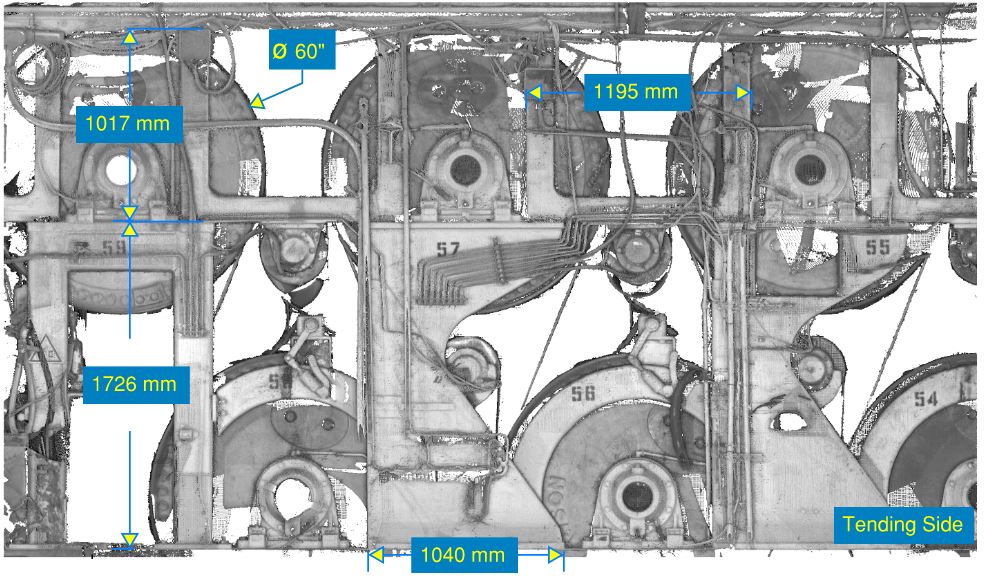
Laser scanning supports digital twin creation by capturing millions of precise 3D measurement points to create accurate virtual replicas of physical assets. This technology transforms real-world objects and environments into detailed digital models that serve as the foundation for digital twins in industrial and construction applications. The process enables organisations to visualise, analyse, and manage their assets throughout their entire lifecycle.
What is laser scanning and how does it create digital twins?
Laser scanning captures precise 3D measurements by emitting laser beams that measure distances to surfaces, creating detailed point clouds. These point clouds contain millions of coordinate points that accurately represent the geometry of physical objects and spaces. The scanning process converts this measurement data into comprehensive 3D models that form the foundation for digital twin development.
The technology works by rotating laser beams 360 degrees while moving vertically, measuring the time it takes for each laser pulse to return after hitting a surface. This process creates a dense collection of coordinate points that accurately represent every detail of the scanned environment. Modern laser scanners can capture thousands of points per second with millimetre-level accuracy.
Converting point cloud data into digital twins involves processing the raw measurement data through specialised software that creates structured 3D models. These models can then be enhanced with additional information such as material properties, operational data, and maintenance records to create comprehensive digital twins that mirror their physical counterparts in both form and function.
What data does laser scanning provide for digital twin development?
Laser scanning generates comprehensive measurement data including point clouds, precise 3D coordinates, surface information, and geometric relationships. Point clouds contain millions of individual measurement points, each with exact X, Y, and Z coordinates that define the spatial position of every scanned surface. This data provides the geometric foundation needed for accurate digital twin creation.
The scanning process captures detailed surface information including textures, colours, and material boundaries when combined with photographic data. This visual information enhances the digital twin by providing realistic representations that help users understand and navigate the virtual model more effectively.
Geometric relationships between different components and structures are preserved in the scan data, allowing digital twins to maintain accurate spatial connections and dependencies. This information proves valuable for understanding how different parts of a facility or system interact with each other.
Additional data layers can include dimensional measurements, volume calculations, and cross-sectional views extracted from the point cloud. This comprehensive dataset enables digital twins to support various applications, from design validation to operational planning and maintenance scheduling.
How accurate are digital twins created from laser scanning?
Digital twins created from laser scanning achieve millimetre-level accuracy, with typical precision ranging from 1–5 millimetres depending on scanning distance and environmental conditions. This high level of accuracy makes laser scanning-based digital twins suitable for precise engineering applications, construction planning, and industrial process optimisation where dimensional accuracy is important.
Several factors affect measurement precision, including scanning distance, surface reflectivity, and environmental conditions such as temperature and humidity. Scanning distance plays a significant role, with accuracy typically decreasing as distance from the scanner increases. Most industrial applications maintain optimal accuracy by positioning scanners within 50–100 metres of target surfaces.
Surface characteristics also influence measurement quality. Highly reflective surfaces like polished metal may produce less accurate readings than matte surfaces, while transparent or translucent materials can be challenging to scan effectively. Understanding these limitations helps ensure appropriate scanning strategies for different environments.
The precision achieved through laser scanning supports reliable digital twin applications across various industries. This level of accuracy enables confident decision-making for facility modifications, equipment installations, and process optimisations based on the digital twin data.
What are the main applications of laser scanning for digital twins?
Laser scanning-based digital twins serve multiple applications including facility management, construction planning, process optimisation, and asset lifecycle management. These applications span process industries, manufacturing facilities, construction projects, and infrastructure management, where accurate spatial information supports better decision-making and operational efficiency.
In facility management, digital twins created from laser scanning help organisations track changes, plan maintenance activities, and optimise space utilisation. The accurate 3D models enable facility managers to visualise equipment locations, measure clearances, and plan modifications without physical site visits.
Construction planning benefits significantly from laser scanning-based digital twins, particularly for renovation and modernisation projects. The technology captures existing conditions accurately, enabling architects and engineers to design modifications that fit precisely within existing structures while identifying potential conflicts before construction begins.
Process optimisation applications use digital twins to analyse workflow patterns, identify bottlenecks, and plan equipment relocations or upgrades. The accurate spatial data helps industrial organisations understand how physical layouts affect operational efficiency and supports evidence-based improvement decisions.
Asset lifecycle management represents another important application area, where digital twins created from laser scanning provide a comprehensive record of facility conditions over time. Regular scanning updates enable organisations to track changes, monitor deterioration, and plan maintenance activities based on actual measured conditions rather than assumptions.
Understanding how laser scanning supports digital twin creation helps organisations make informed decisions about implementing these technologies. The combination of precise measurement capabilities and comprehensive data collection makes laser scanning an effective foundation for digital twin development across various industries and applications. We specialise in providing these digital measurement and modelling services, helping organisations transform their physical assets into accurate digital twins that support better planning, optimisation, and decision-making throughout the asset lifecycle. To explore how these technologies can benefit your organisation, request a detailed quote for your specific requirements.