Maintenance has always been a balancing act. Do it too early and you waste resources. Do it too late and you risk costly failures. The rise of the digital twin is changing that equation entirely, and when you pair it with predictive maintenance strategies, the results are genuinely impressive. This article walks you through how the connection works, why it matters, and what it means for industries that rely on complex physical assets.
At its core, a digital twin is a dynamic, data-driven virtual replica of a physical asset, system, or environment. Unlike a static 3D model, it updates continuously as the real-world object changes. That living quality is exactly what makes it so powerful for maintenance planning.
How real-time data feeds a digital twin
A digital twin only earns its name when it reflects reality accurately and continuously. Sensors attached to physical equipment stream data into the virtual model, covering variables like temperature, vibration, pressure, load, and usage cycles. The twin processes this information and updates its state to match what is happening in the real world at any given moment.
This constant data flow transforms the twin from a snapshot into a living model. Instead of reviewing last month’s inspection report, you are looking at what is happening right now. That immediacy is what separates predictive maintenance from traditional scheduled maintenance, where you replace or service components based on time intervals rather than actual condition.
From asset monitoring to failure prediction
Once a digital twin has enough real-time data, it can start doing something remarkable: anticipating problems before they happen. By analyzing patterns in the incoming data, the system identifies deviations from normal operating behavior. A bearing that is vibrating slightly more than usual, a pipe showing early signs of a pressure drop, a motor running warmer than expected. These are signals that something is changing.
The twin does not just flag anomalies. It can model how a developing fault is likely to progress, giving maintenance teams a realistic window to act. That window might be days, weeks, or months depending on the asset and the fault type. The practical outcome is that you stop reacting to failures and start preventing them, which reduces unplanned downtime, extends asset life, and helps allocate maintenance resources where they are actually needed.
Key industries benefiting from this approach
Several sectors are seeing real, measurable gains from combining digital twins with predictive maintenance.
Process and manufacturing industry
Production facilities and process plants operate complex, interdependent systems where a single unexpected failure can halt an entire line. Digital twins of these environments allow operators to monitor equipment health continuously and schedule interventions during planned downtime windows rather than scrambling after a breakdown.
Construction and infrastructure
For infrastructure owners, the challenge is often managing assets spread across large areas with long service lives. Digital twins built from accurate spatial data allow asset managers to track structural conditions over time, prioritize inspections, and model the impact of deferred maintenance before making budget decisions.
Facility and property owners
Organizations managing large buildings or industrial sites benefit from having a single digital model that integrates mechanical, electrical, and structural data. Rather than relying on disconnected paper records or outdated drawings, they can visualize the current state of their infrastructure and make informed maintenance decisions based on real conditions.
Challenges in implementing predictive maintenance with digital twins
The benefits are real, but so are the implementation challenges. Building a useful digital twin requires accurate, high-quality data from the start. If the baseline model does not reflect the actual asset, the predictions it generates will be unreliable.
Data integration is another practical hurdle. Many facilities run equipment from different eras and manufacturers, each with its own data formats and communication protocols. Getting all of that information to flow into a single coherent model takes careful planning and the right technical infrastructure. There is also the human side of the equation: teams need to trust the system’s outputs and know how to act on them, which means training and change management are part of the picture too.
Finally, maintaining the twin itself requires ongoing attention. As physical assets are modified, upgraded, or replaced, the digital model needs to be updated to stay accurate. A twin that drifts from reality loses its predictive value quickly.
The role of 3D measurement and laser scanning
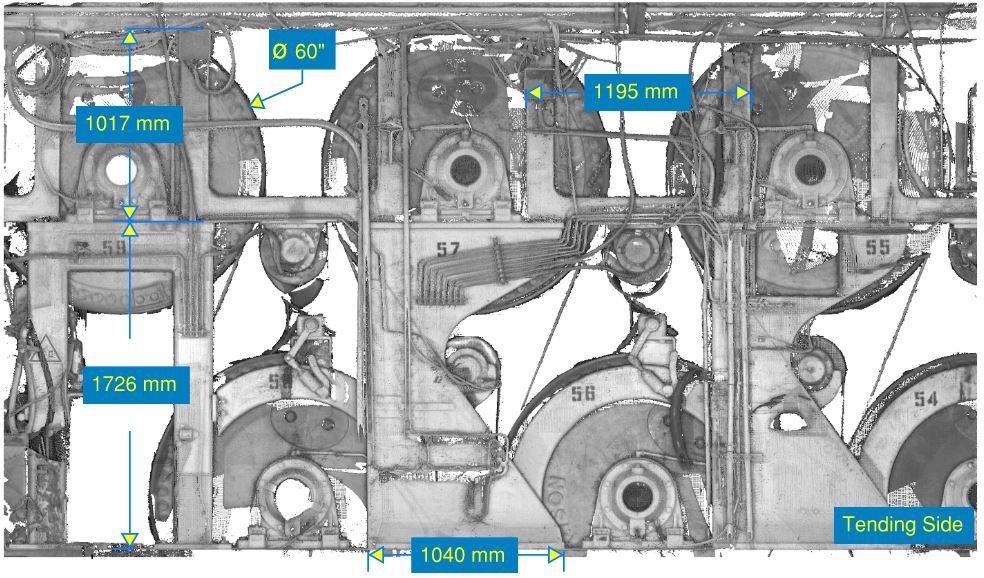
Before a digital twin can do anything useful, you need an accurate representation of the physical asset. This is where reality capture becomes important. Laser scanning, mobile scanning, drones, and photogrammetry are the methods used to capture the geometry and spatial relationships of real-world environments with high precision.
Laser scanning in particular is well suited to complex industrial environments. It captures millions of data points in a short time, producing a detailed point cloud that can be converted into an accurate 3D model. That model forms the geometric foundation of the digital twin, and its accuracy directly affects the quality of every analysis and prediction built on top of it. When the baseline geometry is correct, sensor data can be mapped to the right locations and the twin reflects reality as it actually is, not as it was designed to be. Explore our laser scanning and digital twin services to see how we approach this in practice.
What the future holds for digital twins in maintenance
The direction of travel is clear. Digital twins are becoming more capable, more connected, and more accessible. As sensor technology improves and data processing costs fall, the barrier to building and maintaining accurate twins continues to lower.
In 2026, we are seeing growing interest in twins that span entire facilities rather than individual assets, creating a unified operational picture where maintenance decisions can be made in the context of the whole system. The integration of artificial intelligence into twin platforms is also advancing, enabling more sophisticated pattern recognition and longer-range failure prediction.
For organizations managing physical assets, the question is shifting from whether to adopt this approach to how to do it effectively. Starting with accurate geometry, connecting the right data sources, and building internal capability to act on insights are the practical steps that determine whether a digital twin program delivers real value or stays a proof-of-concept.
At N1digital, we work with organizations across industry and construction to build the foundation that makes all of this possible. We combine laser scanning, reality capture, and digital twin creation to produce accurate, dynamic models that support both day-to-day operations and long-term asset management. If you are ready to move from concept to practice, reach out to our team and let’s explore what the right approach looks like for your assets.