
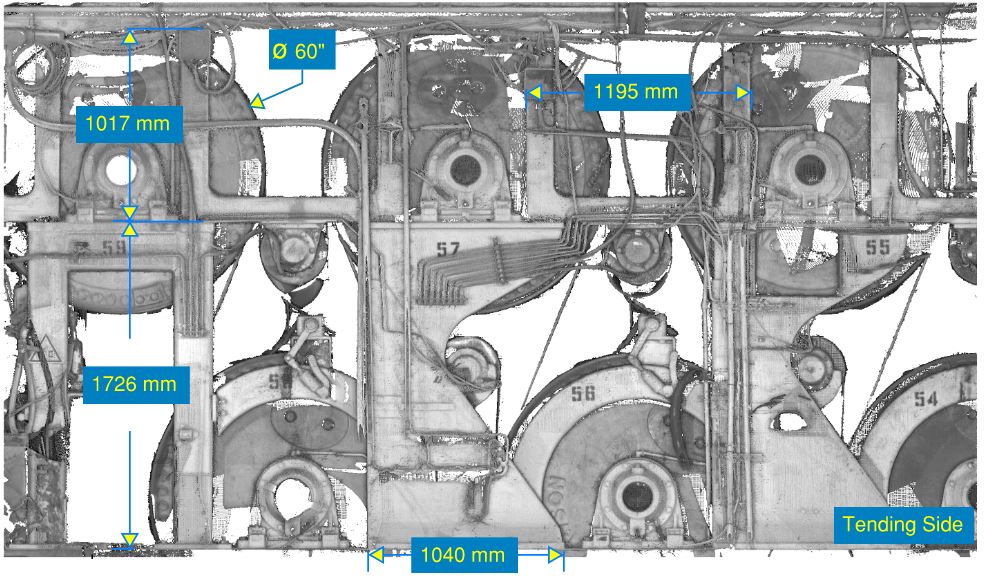
Laser scanning is a measurement technology that captures detailed 3D data of objects and environments using laser pulses. The scanner emits thousands of laser beams per second, measuring distances to create precise point clouds that represent physical spaces. This technology enables accurate digital documentation and modeling for industrial and construction applications.
What is laser scanning and how does it actually work?
Laser scanning works by emitting rapid laser pulses that bounce off surfaces and return to the scanner’s sensor. The device measures the time it takes for each pulse to travel, calculating precise distances to create millions of data points called a point cloud. Modern laser scanners can capture up to one million points per second with millimetre accuracy.
The scanner rotates 360 degrees horizontally and vertically, systematically mapping everything within its range. Each laser pulse records not only distance but also the intensity of the reflected light, which helps identify different materials and surface properties. The resulting point cloud forms a detailed digital representation of the scanned environment.
This process, also known as laser scanning, creates highly accurate 3D models without requiring physical contact with the measured objects. The technology combines advanced optics, precise timing mechanisms, and sophisticated software to transform physical spaces into digital data that can be analysed, measured, and modelled.
What’s the difference between laser scanning and traditional surveying methods?
Traditional surveying relies on manual measurements using tools like total stations and measuring tapes, capturing individual points one at a time. Laser scanning captures millions of data points simultaneously, providing comprehensive coverage rather than selective measurements. This fundamental difference dramatically reduces field time and increases data completeness.
Speed represents the most significant advantage. Whereas traditional methods might take days or weeks to survey a complex industrial facility, laser scanning can complete the same work in hours. The technology eliminates the need for surveyors to access dangerous or difficult areas, improving safety on construction and industrial sites.
Accuracy remains consistently high across the entire scanned area with laser scanning, while traditional methods may introduce cumulative errors over large distances. Industrial laser scanning also captures details that manual surveying might miss, including complex geometries, pipe networks, and structural elements that would be time-consuming to measure conventionally.
What industries benefit most from laser scanning technology?
Manufacturing and process industries rely heavily on laser scanning for plant documentation, maintenance planning, and retrofit projects. The technology excels at capturing complex industrial environments with dense piping, equipment, and structural elements that would be challenging to measure manually.
Construction industry laser scanning supports construction projects from initial site surveys through final as-built documentation. Architects and engineers use scan data for renovation projects, clash detection, and progress monitoring. The construction industry particularly values the technology’s ability to verify that installations match design specifications.
Heritage preservation, forensic investigation, and infrastructure management also benefit significantly from laser scanning. These applications require detailed documentation and accurate measurements that traditional methods cannot provide efficiently. Oil and gas facilities use the technology for safety compliance and maintenance planning in hazardous environments.
How accurate is laser scanning for measurement and modeling?
Modern laser scanners achieve accuracy levels of 1–3 millimetres at typical scanning distances. This precision makes the technology suitable for applications requiring exact measurements, such as quality control, reverse engineering, and precision manufacturing support.
Accuracy depends on several factors, including scanning distance, surface reflectivity, and environmental conditions. Most industrial applications find laser scanning accuracy more than adequate for their needs. The technology maintains consistent precision across the entire scan area, unlike traditional methods where accuracy may vary with distance and accessibility.
Laser scanning and reality capture provides not only high accuracy but also complete data coverage. This comprehensive approach reduces the risk of missing critical details that could affect project outcomes. The technology’s ability to capture millions of accurate measurements ensures reliable data for decision-making and design work.
What can you do with the data from laser scanning?
Point cloud data serves as the foundation for creating detailed 3D models, technical drawings, and digital twins. Engineers use this data for design work, clash detection, and project planning. The information supports both immediate project needs and long-term asset management strategies.
Laser scanning for investment projects enables better planning and risk assessment. Project teams can analyse existing conditions thoroughly before beginning work, reducing surprises and cost overruns. The data supports accurate quantity takeoffs, space planning, and equipment placement decisions.
Measurement and analysis capabilities include volume calculations, dimensional verification, and change detection over time. Facility managers use scan data to track equipment positions, monitor structural changes, and plan maintenance activities. The technology also supports virtual reality applications and remote collaboration, allowing teams to explore and analyse spaces digitally.
Laser scanning data integrates with CAD software, building information modeling systems, and project management tools. This compatibility ensures that scan data becomes a valuable resource throughout project lifecycles, supporting everything from initial planning through ongoing operations and maintenance.
Laser scanning is transforming how industries approach measurement and documentation challenges. The technology provides accurate, comprehensive data that supports better decision-making and more efficient project execution. At N1digital, we combine advanced laser scanning capabilities with digital solutions expertise to help our clients maximise the value of their measurement data throughout their asset lifecycles. For more information about implementing laser scanning solutions, get in touch with our team.