
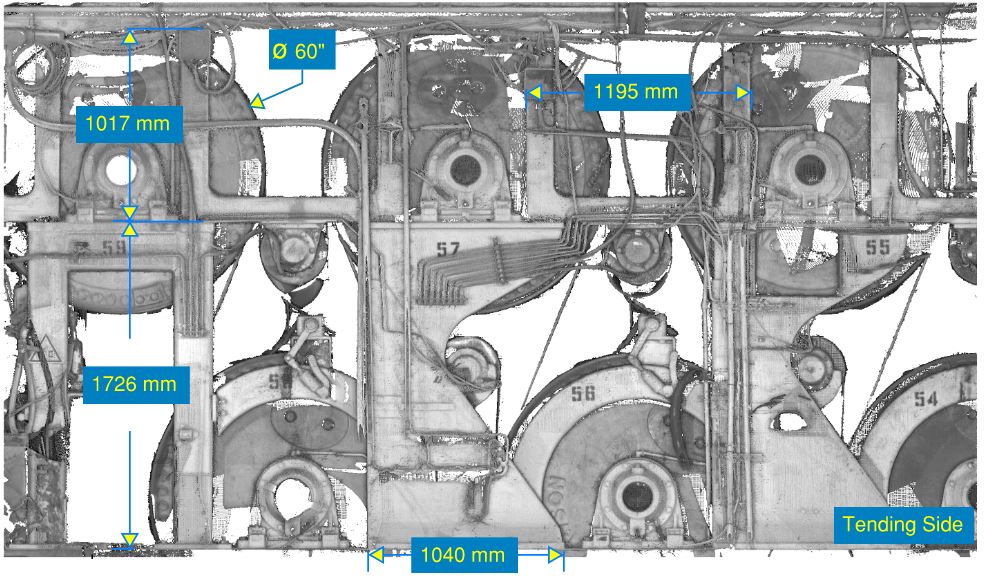
Reverse engineering in laser scanning captures physical objects and transforms them into precise digital 3D models and CAD data. This technology uses laser light to measure surfaces and create detailed point clouds that represent the exact geometry of existing parts or structures. The process enables manufacturers and engineers to recreate, modify, or analyse objects without original design documentation.
What is reverse engineering in laser scanning?
Reverse engineering in laser scanning is the process of digitally capturing physical objects to create accurate 3D models and technical drawings. The technology uses laser scanning to measure millions of points on an object’s surface, generating a comprehensive digital representation of its geometry, dimensions, and features.
This approach transforms physical items into workable digital formats, including CAD files, 3D meshes, and technical documentation. The laser scanner projects light onto the object and measures the reflection to calculate precise distances and coordinates. These measurements create a point cloud that serves as the foundation for digital model creation.
Industrial applications benefit significantly from this technology because it provides accurate measurements of complex geometries that would be difficult or impossible to measure using traditional methods. The digital models support design modifications, quality control, manufacturing planning, and documentation across various industries.
How does the laser scanning reverse engineering process actually work?
The laser scanning reverse engineering process begins with data capture using specialized scanning equipment that projects laser light onto the target object. The scanner measures the time it takes for the light to return, calculating millions of precise coordinate points that represent the object’s surface geometry.
The captured data forms a point cloud containing detailed spatial information about every scanned surface. This raw data requires processing to remove noise, align multiple scan positions, and create a unified dataset. Professional software converts the cleaned point cloud into various digital formats, including mesh models, CAD surfaces, and technical drawings.
Industrial laser scanning follows these typical stages:
- Initial scanning setup and calibration for optimal data capture
- Multiple scan positions to capture all object surfaces completely
- Point cloud processing and alignment of different scan positions
- Surface reconstruction and mesh generation from point data
- CAD model creation with precise dimensional accuracy
- Quality verification against original object specifications
The final output provides engineers with accurate digital representations that support design work, manufacturing planning, and quality analysis. This systematic approach ensures that the digital model maintains the precision required for professional applications.
What types of objects and projects benefit most from laser scanning reverse engineering?
Industrial equipment and machinery components benefit most from laser scanning reverse engineering, particularly when original design documentation is missing or outdated. Complex geometries, custom parts, and legacy equipment are ideal candidates for this technology because traditional measurement methods cannot capture their intricate details effectively.
Construction laser scanning supports architectural restoration projects, infrastructure documentation, and building information modelling. Historic buildings, bridges, and industrial facilities require precise digital documentation for renovation planning, structural analysis, and maintenance scheduling.
Manufacturing applications include:
- Automotive parts requiring precise fit and dimensional accuracy
- Aerospace components with complex curved surfaces and tight tolerances
- Custom tooling and fixtures for production line optimization
- Prototype development and design verification processes
- Quality control comparison between manufactured and designed parts
Process industry equipment such as pipes, vessels, and structural components benefit from reality capture technology for maintenance planning and modification projects. The ability to create accurate as-built documentation supports investment planning and operational optimization across industrial facilities.
What’s the difference between traditional reverse engineering and laser scanning methods?
Traditional reverse engineering relies on manual measurement tools like callipers, gauges, and coordinate measuring machines to capture object dimensions point by point. This approach requires significant time investment and often cannot capture complex curved surfaces or intricate geometries with sufficient accuracy for modern applications.
Laser scanning technology captures millions of measurement points simultaneously, providing comprehensive surface data in a fraction of the time required for manual methods. The laser-based approach reduces human measurement errors and provides consistent accuracy across the entire object surface.
Key differences include:
| Aspect | Traditional Methods | Laser Scanning |
|---|---|---|
| Speed | Hours to days per object | Minutes to hours per object |
| Accuracy | Limited by tool precision | Sub-millimetre precision |
| Surface Coverage | Selected points only | Complete surface capture |
| Complex Geometry | Difficult or impossible | Handles any geometry |
Traditional methods work well for simple geometric shapes with accessible surfaces, but laser scanning excels with complex parts, large objects, or items requiring comprehensive digital documentation. The choice depends on project requirements, accuracy needs, and available resources.
How accurate is reverse engineering with laser scanning technology?
Modern laser scanning technology achieves sub-millimetre accuracy for most industrial applications, with high-end systems capable of measuring within 0.1 mm or better. The actual precision depends on scanner specifications, object surface properties, environmental conditions, and proper calibration procedures.
Laser scanning and reality capture systems meet the industrial quality standards required for manufacturing, inspection, and documentation purposes. Professional-grade scanners provide measurement uncertainty specifications that allow engineers to determine suitability for specific accuracy requirements.
Factors affecting measurement accuracy include:
- Scanner resolution and measurement technology specifications
- Distance between the scanner and target object surfaces
- Surface material properties and reflectivity characteristics
- Environmental conditions such as temperature and vibration
- Proper calibration and measurement setup procedures
Quality verification involves comparing laser scan measurements against known reference standards or coordinate measuring machine results. This validation ensures that the digital model meets the required precision levels for its intended application, whether for manufacturing, analysis, or documentation purposes.
Laser scanning for investment projects provides the measurement reliability needed for critical decision-making in industrial projects. The technology’s proven accuracy supports confident planning and implementation of modifications, upgrades, and new installations based on precise as-built documentation.
Professional laser scanning delivers the measurement precision and comprehensive data capture that modern engineering projects require. We combine advanced scanning technology services with expert processing capabilities to transform physical objects into accurate digital models that support your design, manufacturing, and analysis needs with complete confidence in the results. For project-specific requirements and detailed information, request a quote today.